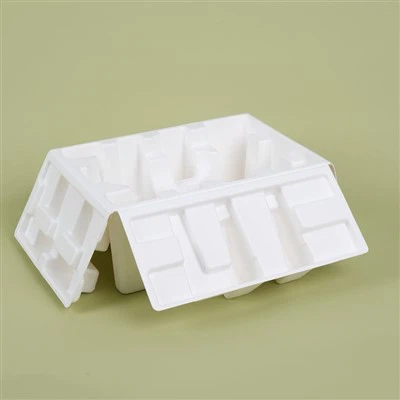
As sustainable packaging continues to replace traditional plastic materials, pulp molded packaging has become one of the fastest-growing packaging solutions worldwide. Its excellent cushioning performance, recyclability, and cost efficiency make it ideal for electronics, home appliances, cosmetics, medical devices, and industrial products.
But how is molded pulp actually manufactured?
This article explains the complete pulp molding process, helping buyers and product engineers better understand how high-quality molded fiber packaging is produced.

1. Raw Material Preparation
Everything starts with fiber.
Most molded pulp products are manufactured from recycled paper, corrugated cardboard, newspaper, wood pulp, bamboo fiber, or sugarcane bagasse. Different raw materials provide different characteristics.
For example:
Recycled corrugated paper offers excellent strength.
Sugarcane bagasse creates a smoother surface with a lighter color.
Wood pulp provides better consistency for premium packaging.
The fibers are mixed with water inside a pulping system to create a uniform slurry.
2. Pulp Forming
The pulp slurry is transferred to a forming machine.
A specially designed aluminum mold is submerged into the slurry while vacuum pressure pulls fibers evenly onto the mold surface. Water passes through the mold while fibers remain, gradually forming the desired packaging shape.
The thickness of the product depends on factors such as:
Fiber concentration
Vacuum pressure
Forming time
Mold design
Proper control of these parameters ensures consistent product dimensions and strength.
3. Dewatering
After forming, the product still contains a large amount of moisture.
Vacuum suction removes most of the free water before the product moves to the next stage. Efficient dewatering reduces drying time and improves production efficiency.
4. Drying and Hot Pressing
Drying is one of the most important stages in molded pulp manufacturing.The drying and hot pressing process differs depending on the manufacturing method.
- Dry Press Process
After vacuum forming, dry press products still contain a high amount of moisture. They are first dried in a tunnel dryer or by natural air drying until reaching the required moisture content. The products are then transferred to a hot press, where heat and pressure improve dimensional accuracy and structural strength.
- Wet Press (Thermoformed) Process
For wet press products, the semi-moist preform is transferred directly from the forming mold to the heated press without a separate drying stage. During hot pressing, heat and pressure remove the remaining moisture while simultaneously shaping the final product. This process produces smoother surfaces, higher dimensional accuracy, and a premium appearance.
Depending on product requirements, manufacturers may use:
- Natural drying
- Drying ovens
- Hot pressing systems
For premium packaging, thermoforming or hot pressing improves:
- Surface smoothness
- Dimensional accuracy
- Edge definition
- Product appearance
This process is commonly used for consumer electronics and premium retail packaging.
5. Trimming and Finishing
Once dried, the products are trimmed to remove excess material.
Depending on customer requirements, additional processes may include:
- CNC trimming
- Die cutting
- Edge finishing
- Logo embossing
- Printing
- Surface coating
A clean finish improves both functionality and product presentation.
6. Quality Inspection
Every production batch should undergo quality inspection before shipment.
- Typical inspection items include:
- Dimensional accuracy
- Wall thickness
- Compression strength
- Appearance
- Moisture content
- Drop protection performance
Consistent quality control helps ensure packaging performs reliably during transportation.
7. Packaging and Delivery
After inspection, molded pulp products are stacked, packed, and prepared for shipment.
Proper packaging helps prevent deformation during transportation while maximizing container utilization.
Choosing the Right Manufacturing Process
Different products require different molding technologies.
For example, protective industrial packaging may prioritize structural strength, while consumer electronics packaging often requires smoother surfaces and tighter dimensional tolerances.
Selecting the right process depends on factors such as:
- Product weight
- Fragility
- Production volume
- Appearance requirements
- Shipping conditions
Working with an experienced manufacturer can significantly shorten development time and improve packaging performance.
Conclusion
The pulp molding process combines material science, precision tooling, and manufacturing expertise to produce environmentally friendly packaging solutions.
As global demand for sustainable packaging continues to grow, understanding how molded pulp is manufactured helps businesses make better packaging decisions while reducing environmental impact.
Whether your project requires protective industrial packaging or premium retail presentation, choosing the appropriate manufacturing process is the first step toward achieving reliable and sustainable packaging.
The 7 Main Steps of Pulp Molding Process